Muraji'
-مُرَاجِع
About the method
Overview
This app implements a more effective revision method - (1) Spaced repetition (2) of ruku's (3) in interleaved order. I will explain what each of these 3 mean, and how they improve over the usual method of doing a full loop over 1-2 months.
You will be covering one ruku' at a time and can finish the Quran in 3-6 months. Once complete - the minimum daily workload exponentially reduces to a few pages a day.
Challenges with the usual method
- When covering a rough patch in the Quran, you face more frequent hits of discouragement that reduce consistency, or worse, cause burnout
- You give equal attention to all parts of the Quran, both the difficult and the easy parts. The hardest parts deteriorate over the years because reading them once a month is not enough.
1. Spaced Repetition
Each card returns after a duration calculated as early as 20 minutes to 6 months later. Thus, easy cards are spaced out to increase focus on hard cards, and the intervals steadily increase.
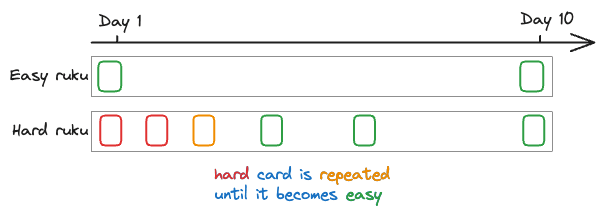
2. Interleaved order
The cards will appear from different parts of the Quran. There are several benefits to this:
- Interleaving prevents you from forming "lazy hooks" and creates a refreshing challenge — knowing an ayah from recent context rather than what you recited 2 pages ago (example: Is this the first or second "يُحَرِّفُونَ الْكَلِمَ" in Surah Maidah).
- It makes the reward/pain variable — you don't know what you will read on a given day and how you will perform. This is psychologically proven to increase dopamine.
- It smooths out the effort — you don't get stuck working through several hard ruku's, making the sessions harder and increasing short-term workload through each card requiring frequent repetitions.
3. Why Ruku's
Ruku's form complete thematic units spanning 0.5 to 2 pages. As we move between different parts of the Quran, it is better to stop at a ruku—at a natural end to a topic—instead of a page, which can be abrupt message-wise.
What is a ruku? (رُكُوع)
Ruku's were a scheme of portioning the Quran into sections that are appropriate to recite as a unit in Salah. In non-Arabic speaking regions such as Central Asia and the Indian sub-continent, these were explicitly marked in the mushaf. The most widely accepted portioning is 556 ruku's each ranging from half a page to 2 pages.
4. Tips and mindsets
- In your first pass through the Quran, we consider 2 mistakes/ruku acceptable. Going from your current Hifz state to perfect memory will take longer if we try to do it in one pass. Think of it like accelerating from standstill to top speed: you must start with the first gear and get to 20 mph first.
- After reciting a ruku, spend a moment to look over each mistake, holding the following question gently in your mind as you do so: “How can I remember this mistake next time?” This is more efficient than eliminating mistakes through brute-force repetition.
- The review intervals increasing after you make mistakes can feel disorienting, but this is intentional. Long-term retention is strengthened when you review at increasing intervals and challenge your memory. The best time to review is when you are about to forget. However, the process is probabilistic and allows for some relapse. Mistakes may re-occur and reset a ruku's status to "hard" or "again". Do not expect linear progress to perfection. The protocol allows for some regression because ensuring regression (easy -> hard) never happens requires monumental unsustainable effort.
- Save to home screen to reduce friction